


USER STORY
Conversion of Production Facilities: Safe Retrofit, Installation and As-built Documentation with Laser Scanning

Contents
From Physical Reality to Actionable Insights: Capturing the Existing State
The Challenge: Adapting Production Infrastructure Within an Existing Concrete Shell
How the Survey Was Performed: FARO Laser Scanner + Point Cloud Registration in FARO Scene
Processing the Point Cloud: From Scan to CAD-ready Data
Why 3D Scanning Is Essential for Industrial Retrofit Projects
From Physical Reality to Actionable Insights: Capturing the Existing State
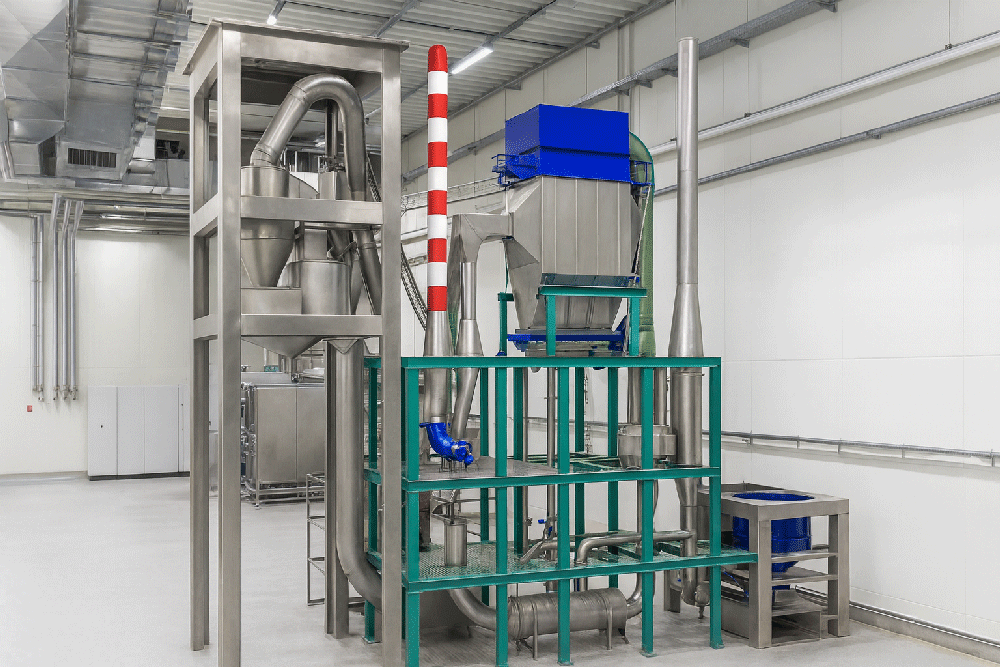
In a major project by Intercem Engineering GmbH, a leading supplier of turnkey solutions for cement plants, 3D laser scanning technology was deployed to support the conversion and upgrade of existing production infrastructure. The project involved the retrofit of an existing filter system on a concrete building and the installation of a new cyclone with a filter system within the concrete framework of a heat exchanger.
Because precise as-built documentation was essential to plan prefabrication and avoid costly rework, the team chose to use 3D laser scanning. The method proved to be fast, efficient and safe — even in hard-to-access areas, providing a robust digital foundation for retrofit planning.
The Challenge: Adapting Production Infrastructure Within an Existing Concrete Shell
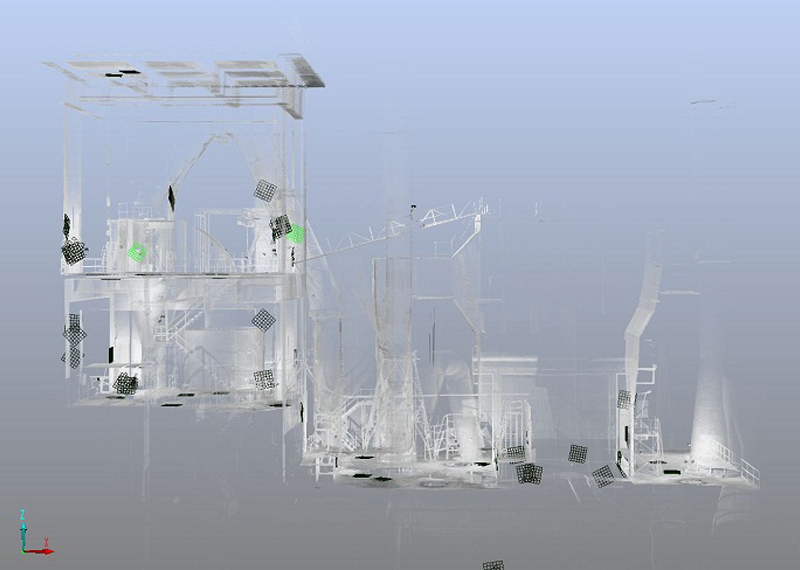
Retrofitting a filter system and installing a new cyclone in an existing concrete structure poses multiple challenges:
- Exact compatibility required between new equipment and existing geometry – tolerances had to be respected to avoid alignment issues.
- Some areas of the building were difficult to access, making manual measurement hazardous or unreliable.
- Any misfit would lead to costly rework, shutdowns or delays in installation.
In this context, traditional measurement methods bear high risk. 3D laser scanning offered a precise, comprehensive and reliable alternative.
How the Survey Was Performed: FARO Laser Scanner + Point Cloud Registration in FARO Scene
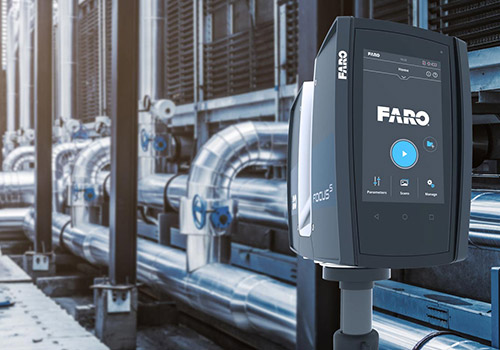
For this project, a laser scanner by FARO was used. For the retrofit of the filter system, 7 scans were made; for the heat exchanger area, 10 additional scans covered the relevant geometry.
After data capture, all scans were registered and merged in FARO Scene, producing a unified point cloud of the building’s interior geometry. This ensured high accuracy and comprehensive coverage – even in difficult-to-reach zones.
Processing the Point Cloud: From Scan to CAD-ready Data
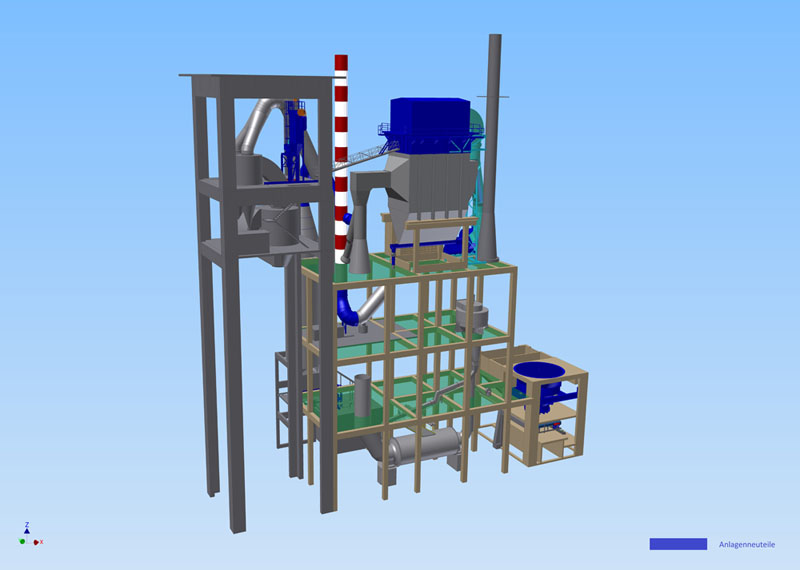
Once the point cloud data was ready, PointCab Origins was used to define floor plans and sections from the scan data easily and quickly. Then, the resulting CAD-ready data was imported into the mechanical CAD software Autodesk Inventor, where final modeling took place.
This Scan-to-CAD workflow provided:
- Accurate floor plans and sectional data based on real-world conditions
- A reliable basis for the prefabrication of new components (filter system, cyclone)
- Minimized risk of misalignment, rework or installation errors
Why 3D Scanning Is Essential for Industrial Retrofit Projects
This case highlights several key strengths of 3D laser scanning in industrial environments – especially when modifying existing facilities:
- Precision: Point clouds capture true as-built geometry, including irregularities or deformations in old concrete structures.
- Coverage: Even hard-to-access areas are recorded — no need for manual measuring in confined or hazardous zones.
- Planning reliability: CAD/CAD-BIM models generated from scan data allow for prefabrication and exact fit of new installations.
- Time and cost savings: Avoiding on-site rework, installation delays or retrofit errors reduces overall project risk and expense.
In short: for industrial retrofit and conversion projects, 3D laser scanning is often not just useful — it is indispensable.

Want to keep up with the latest pointCab news?
Then follow us on Social Media or subcribe to our newsletter!